
Things I like about watching John Wick in chronological order
This does not quite do what it says on the tin but it’s close

“For Rose, as for most teachers of Hegel for beginners, the central ‘stumbling block’ was the fabulously dramatic ‘Lordship and Bondage’ section of the Phenomenology, in which consciousness becomes aware of itself as consciousness not while sitting and studying in a little room, but out there in mortal struggle with another consciousness. ‘Self-consciousness exists in and for itself when, and by the fact that, it so exists for another’: Acknowledge me, you bastard, or I’ll kill you. No, you acknowledge ME, fuckface, or I’ll kill YOU. And so, for a while, the stronger one gets on top and forces the weaker to do all the work. ‘The satisfaction is itself only a fleeting one, however,’ as the bondsman, forced to work and ‘infected’ by fear of death, discovers that he is the one who can actually make things, that he ‘himself exists essentially and actually in his own right’. This moment is the crucial one for Marx and Marxists, for obvious reasons, and for the existentialists. It’s central too, in spite of Hegel’s many racist assumptions, to great thinkers of the African diaspora, W.E.B. Du Bois and Frantz Fanon, for example, Paul Gilroy.” — Jenny Turner, What else actually is there?
****
— Feeling like I am somehow having a 45 year old man’s wet dream
— The shot around 21:20 where Alfie Allen idiot punk gets out of the car crotch-first to the camera to emphasise what a dick he is; this is actually the first moment at which I feel like something interesting might be happening artistically
— The “badass cool guy” music running for the clean-up crew
— Willem Dafoe juicer
— Willem Dafoe camel houserobe
— Willem Dafoe grand piano
— Assassin hotel concierge accent
— I get annoyed by the dead wife trope. Then I get bored. Then I get intrigued with it again because I wonder what it is about having a dead wife that makes men horny. Soon I conclude that I will never know.
— Whole film is weirdly horny in a general sense, which I kind of appreciate
— Is it because she dies without knowing what a fuck up you are? Is that the appeal? Like you’re getting away with it? Extracted love from someone you had no right to?
— The music is really shamelessly mid-2000s I wanna be a badass type stuff and I enjoy the cheesiness
— Ron Perlman looking doorman. This is the first person on screen I have been attracted to so far. Usually I like Keanu but I find him unreachable in this role. The doorman is sexy to me.
— Actually the shot at around 49:39 where Keanu is looking deeply into the henchman’s eyes while he stabs him in the neck very slowly is pretty hot
— Also when he points the gun at Iosef and then without breaking eye contact points it down at the goon he has in his hands and shoots him instead, this is what we in the business call foreplay
— When he just starts shooting people on the dancefloor. Introverts unite, we have nothing to lose but our chains
— Keanu kind of looks like my therapist
— I like the head of security telling off the boy. I am now slightly out of chronological order. This will happen again in a couple more places.
— ASSASSIN HOTEL CONCIERGE ACCENT
— For two seconds when I saw Keanu with the shirt off I was like this fuckin doctor better not be a woman; reverse shot reveals elderly Chinese man. Outstanding.
— I should clarify I am not a misogynist, women can be doctors, I just did not want generic heterosexual tension inserted into the movie that is horny about guns because I am an aesthete
— Watch face on the inside of the wrist! Very interesting detail
— Willem Dafoe sniper rifle
— Charon really is super attractive actually I take back what I said about the doorman being the first guy in this that I’m into
— I do dislike that Keanu didnt kill Perkins but I do kind of enjoy that this artistic decision was foreshadowed by her calling him a pussy
— Shoot out in a church!
— See you didn’t kill Perkins and now she killed Harry! Boundaries are so important! If you don’t enforce them then this is what you get.
— If he’s so dangerous they should have just shot him in the car park. I don’t get it.
— Viggo is intensely infatuated with Wick in the torture scene, do straight men clock this? They must clock this. I mean it’s not Daniel Craig Mads Mikkelson Casino Royal horny but those two are textually gay and consistently sexual while this is just thematic and aesthetic and more about love.
— Oh but he keeps him alive because sadism is more important than safety. Duh.
— I like the luck theme
— I like the “lying to yourself that the past had no sway over the future, but in the end, a lot of us are rewarded for our misdeeds” speech
— It clings to you… We are cursed, you and I, … hot.
— Willem Dafoe sniper rifle!
— I like that John Wick believes in himself even while actively getting smothered to death with a plastic bag over his head.
— Give me your son is kind of horny also sorry
— The very big gun at 1:13:06
— Cool it cool it cool it cool it cool it — John! (So cute)
— The world of family is not important, what is important is the world of men, with the big guns which lead to big explosions. Freud.
— Finally at 1:16:15 the moneyshot (Iosef getting killed)
— CHARON
— Charon is a great name for this character
— Marcus coming in at the end…. Husbands. Husband material.
— See now here comes a woman to spoil it!!!!
— Did Willem Dafoe (Marcus) really take the hit job in order to have a cover story to follow John Wick around and protect him?????? That’s gay as fuck bro (positive).
— Oh no Viggo figured it out
— POOR MARCUS
— Perkins is really bothering me. This isn’t a list of things I enjoyed anymore in part because of her. This character is embarrassingly thin and that’s saying a lot in a pretty thin characterisation movie. What’s her motivation? Why does she throw her life away? Gold-digging bitch isn’t a personality!
— Picture of Marcus :( a second dead wife has hit the twin towers
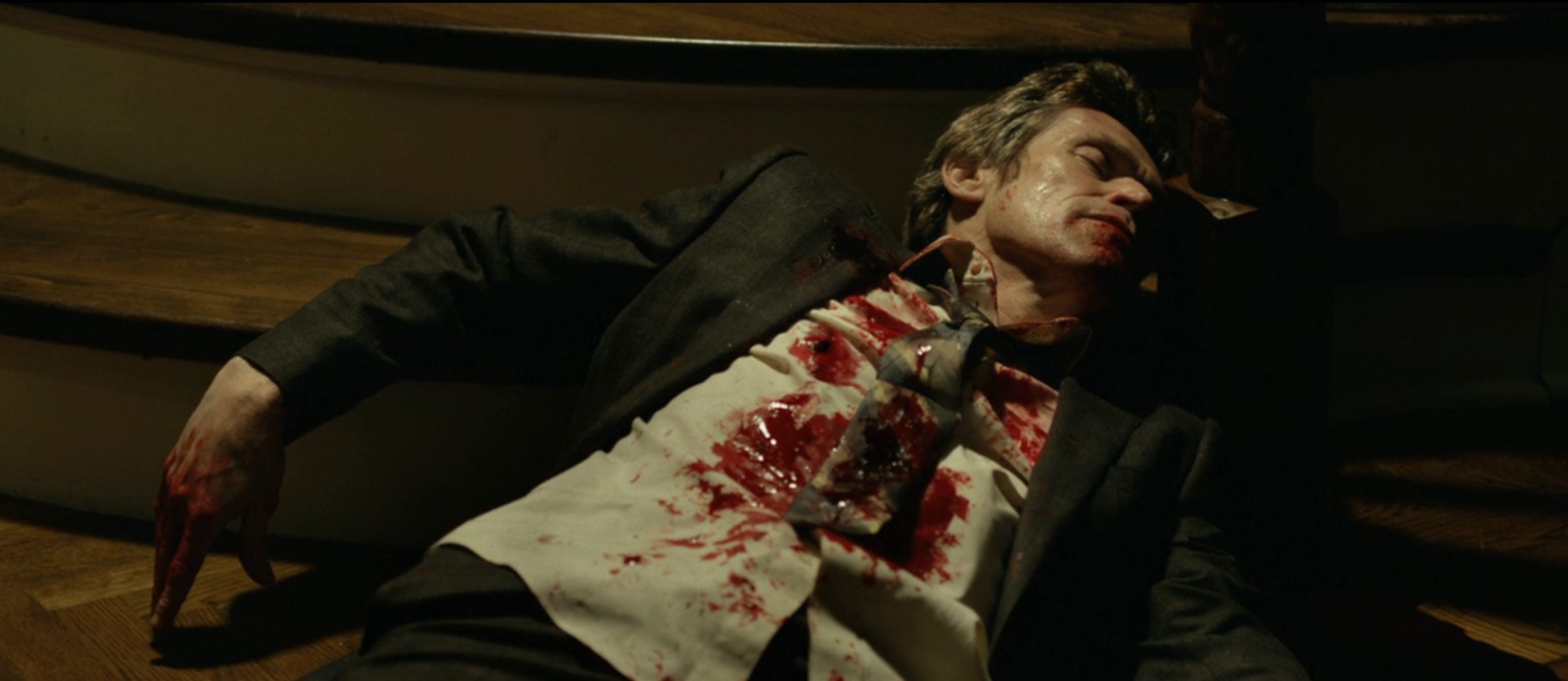
— By thine own haaaaaand, revoked. Stellar delivery from Ian McShane. God I love him. Did you guys ever watch the show where he’s like King David or Saul or whatever? Sebastian stan plays his gay son. McShane is kinda playing gay here too, but plausibly deniably british.
— I am satisfied by the death of Perkins.
— Oh I see, the gold coins are some kind of assassin world currency, tying into the Charon theme. I thought they were literally gold bullion. Maybe they are also that.
— Clean up crew!
— “God damn I knew he’d come” this is the whole thing in one sentence I think. Like this is the whole appeal of these movies.1
— Viggo is having so much fun here did he kill Marcus in order to get John Wick to come kill him? Toxic behaviour.
— Nice to see a role for a safety bollard. Civil Engineering isn’t dead.
— I find the deployment of the word cocksucker here quite surprising. Nothing has tonally prepared us for this, although it would also be worth noting that this movie doesn’t really have a tight grip on tone or theme, so perhaps I shouldn’t be surprised by this. Alternatively, this might be encouraging us to read Viggo as gay. But I don’t think so. I think this line was written by a straight man to whom it means almost nothing. Just my personal guess. To be clear, I don’t mind it.
— Is this a comic book movie. I’ll be pissed if I’ve accidentally watched a comic book movie.
— I have a feeling they actually dropped a real car off that dock and I appreciate it.
— No more guns, John. No more bullets!
— They’re in love.
— Just you and me John!
— You and me.
— What happened to us John? We were professionals… civilised …
— Do I look civilised to you?
— I like the intentional self-stabbing thing as a way to take possession of the knife
— Be seeing you, John.
— I like the new dog!
****
If you haven’t watched John Wick I can tell you in advance that the experience pairs well with exogenous testosterone.
I worry that my recap above may have seemed overly negative. Killing the dog is still interesting. Forcing people to sit through a full 15-20 minutes of domestic drama is interesting, like Eco pushing you 200 pages of semiotics out the front of the name of the rose. Especially because you are forced to make sense of that 20 minutes, and lest you forget, the text will later remind you that only an idiotic dumbfuck like Iosef could fail to see how important that is, what it means, what it was.
The cynic or perhaps the scholar of fascism might say that the attraction of the dead wife is that she is the ultimate excuse for violence, but I don’t think that that is what is going on here viscerally, nor do I think the violence on display here is fascist nor even fash-adjacent. There are very distinct types of violence, as any connoisseur can tell you. It would be very easy, in fact it would seem very natural, to make a fascist film out of the premise of avenging the dead wife, but that is not what this film is, in part because the film avenges the puppy, and concedes that sometimes, as in the case of this wife, there is nothing to avenge.
And also I think men are enamoured of the dead wife. I think violence can be about love. I think revenge is a real thing and I also think love is quite tricky. I think perhaps less charitably now that the best wife is the dead wife, for at that moment, she slips back into fantasy and symbolism, without the noise and drama of the real. At the very least this absolutely must be true on screen, for where there is a real, living wife in the picture there is a risk that one stumbles into another genre, particularly a romance genre, and that is gay.
I found the first 15-20 minutes pretty generic and cheesy, because I have watched approximately 900 arthouse films about grief all of which were better treatments of that subject matter than this.2 But I did not look away from it the entire time, despite the fact that I was at home on my laptop with 5 million ample distractions. So there is definitely something to it, probably because they’ve set us up with that shot of him bleeding in the first place, and we’re wondering how this hallmark B-movie about grief is going to descend into that, which is interesting to us because the wife is already dead so you’re thinking what more is there to lose, and part of the point of the film is that there is always more to lose, as long as you’re breathing you are eminently vulnerable; there are shades of the Shakespearean treatment of grief and betrayal by the world; I am worse than ere I was and worse I may be yet.3 And so one waits for the moment. There are elements of filmmaking that are underrated in the arthouse, and one of them is suspense.
There is also something in here about being able to extract some measure of justice, and thus impose some measure of order, on a random and uncalculating world.
Why is Charon so much more interesting than Perkins, why does he feel thicker as a character? Initially I wanted to say I don’t think it’s just the accent, but actually, I think the accent is doing a lot of the work! A kenyan accent in this setting is telling you that this guy has a past, he has history; he is not here by default, and so he probably cares a lot about the institution or the hotel or something associated with it. If he doesn’t, then he is stuck here, and that would be interesting also.
The problem with Perkins is that she’s a generic american tough chick in a generic american tough setting. There’s no texture, there’s no beautiful suggestion of a past. (This is also why Addy is boring.) Philip Seymour Hoffman talked about how there has to be something mysterious about a character in order for us to feel that what we are witnessing is real — in fact, he says the characters must feel real enough for us to project something onto them, and that this requires mystery. Life is incongruency. As Lance Reddick’s portrayal of Charon shows, that mystery requires work. (Here’s what Hoffman actually says: “If they’re not fully fleshed out people, they’re not mysterious… if you haven’t done all that work, they’re not mysterious enough.”) Longtime readers of my art project already know that I think flattening yourself down into one thing or demanding a neat legibility from oneself is a complete recipe for death. One is never one or the other thing; one is thin, too thin, unless one finds some way to become multiple, round, indescribable. For that one must hold internal tension; more than that, one must learn to love that internal tension, as though it were a vital sign of life. This too requires lots of work. In some ways this work must be furious, for, from the same Jenny Turner essay from which I take the epigraph above, the eulogy for her teacher Gillian Rose: “We start life so full of life, with so much in us, so much more than we can ever comprehend. Then life itself knocks it out of us, and philosophy begins.”
Work! The work it takes to claw life back. One can conceive of Wick’s violence as this work. The implication being that without hope — or justice, its semblance — Wick will find no way to be alive. This is not entirely without philosophy, but sometimes a philosophy needs a life breathed into it via acts. Some of the cheesiness is shorn off this by the ballistic exposition. Why deny it? Don’t be scared to admit that some violence is good. We’re all words here, words and images. Take my hand, we’ll admit that we like it together. The last scene of the film, when John adopts a new dog, does present a synthesis of both of the Johns. I thought it was very nice.
Thanks to our friends at the LRB above, I think we can make another reading: Fundamentally John Wick is about the triumph of labour over capital. Viggo’s empire, which his spoiled son Iosef inherits without learning the provenance of its value, is built on the back of John’s labour. Because John made it, he can unmake it — Viggo knows this and would not fuck with him, but Iosef, who has been alternatingly both coddled and brutalised by his father, knows nothing of the world. Because of that ignorance, his greed has no limit. John becomes the battered victim of a structure he himself has built: the power he has given over, and the indolence resulting from the gift. John is the dead wife who rises from the grave; it is John and Viggo together that make empire, make everything. The more Viggo protects his son from this knowledge and its consequences, the worse everything seems to get. It is the comfort of the ruling classes that generates the bad violence.
In this reading, the pivotal scene is not the death of Iosef but rather the destruction of the vault behind the church. The vault is irreplaceable without John, because John is the tool through which it was made. I am absolutely sure that Viggo wishes he had given John his son before the vault went up in smoke. Viggo — excuse me, for I must say it — with his own tool can make another son.
Anyway, is John Wick Heated Rivalry for men?
****
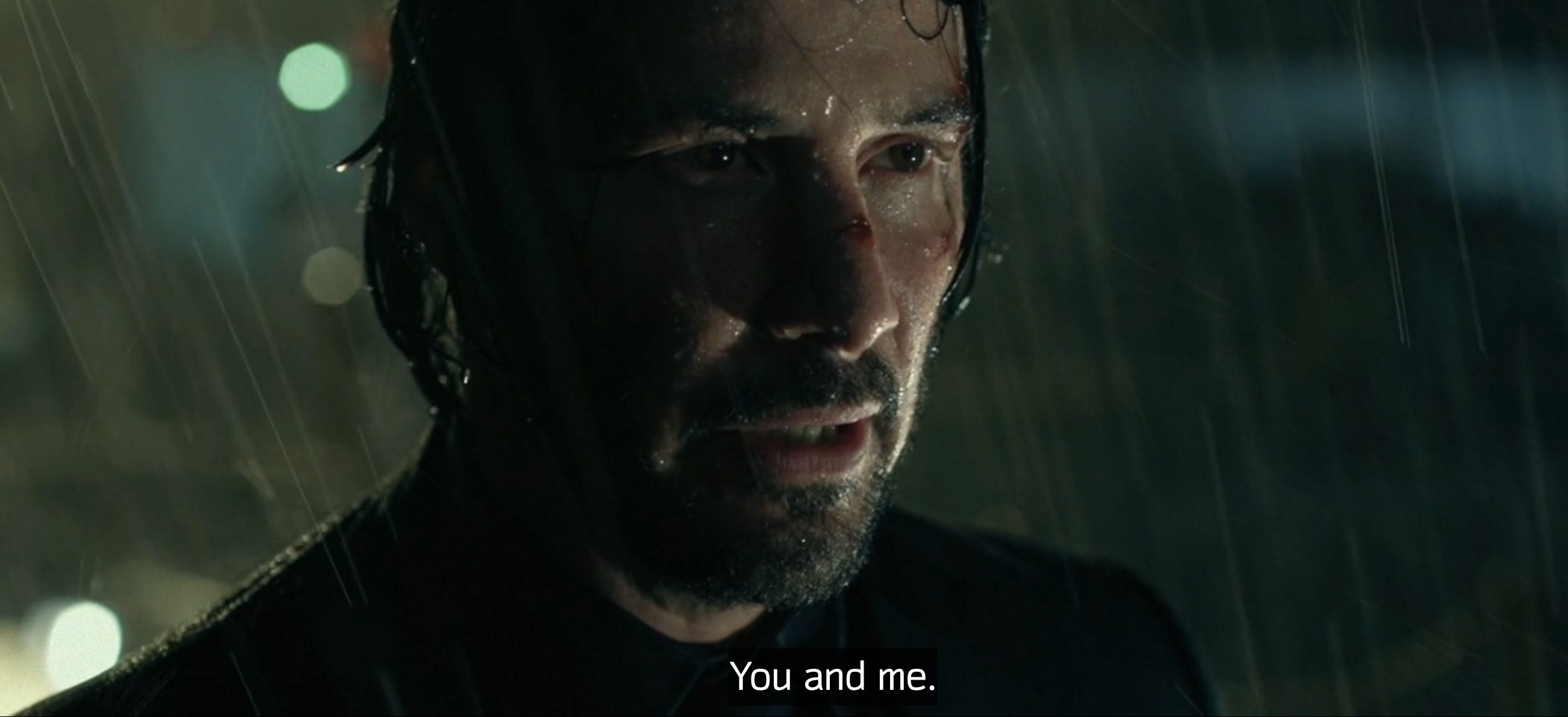
[Emmanuel Macron voice: Dependable. Reliable. Loyal.]
In fact, if you like a luck theme, you should watch Jafar Panahi’s It Was Just An Accident, although I suppose in fact that film is more about trauma, and trauma and grief are very different subjects despite how very often they go together. To me the most devastating modern film about grief is Alice Rohrwacher’s La Chimera. Tom Ford’s A Single Man is the sexiest film about grief. I think PTA’s Magnolia is a grief film, and so is Licorice Pizza, about the grief and stupidity of growing up; Anora is that kind of film also. The Darjeeling Limited has a lot of good stuff about grief in it. The Brutalist is also about grief. The weirdest grief film is Don’t Look Now (1973). Of course the real master of grief in film is Tarkovsky.
I think grief becomes much more endurable at the thought that it might one day soon be transformed into violence. That is in Shakespeare also and that is not always wrong. Listen, babe, whatever gets you through. And Iosef deserves it. (I am going contra Simone Weil here.)
RE: why straight men like dead wives: my perspective is that the dead wife does not appeal inherently but as a device, namely, to produce a middle-aged man who is single for a non-embarrassing reason, with a clean slate and the narrative tension of unsatisfied virility.
Or, to attempt an aphorism in your style: the existence of the wife tells us the man has a load to blow; the fact that she is dead tells us he needs somewhere to blow it.
This was fun.
I liked what you wrote here: "part of the point of the film is that there is always more to lose, as long as you’re breathing you are eminently vulnerable...The implication being that without hope — or justice, its semblance — Wick will find no way to be alive."
I have a slightly different take on this but I can't quite get at it. Justice is not in the frame here. This film is about stylised violence. But leaving that aside, this film is about nihilism (I would say that, wouldn't I?). John sort of wants to commit suicide (this is the vulnerability), but the Babba Yagga committing suicide would be gay, so John instead exploits a pretext to get other people to shoot him, but he must make it hard for them because for Babba Yagga anything less would be gay. To motivate them, he gradually draws them into his suicidal nihilistic vortex e.g. by killing the boss' son, by torching the vault and, in the 2nd film, killing in the hotel. Nobody can have any meaning or joy, only violence and death. John's vortex is sustained by the visceral, heart pounding experience of *competence*. Man, nothing makes you feel alive like viscerally demonstrating your hard earned competence, preferably in a way that gets you literally covered in viscera, hence slowly stabbing the guy in the neck. That's ambrosia for Wick.
I enjoyed the capitalist reading, though I think the point of John Wick is for it not to be read (I kind of want to say that reading John Wick is gay. There, I said it. The movie must be aggressively anti gay at its core so that it can go full Tom Ford on the stylishness. That's my reading. Ugh, deconstruction is inescapable; curse Derrida). Anyway, love this: "It is the comfort of the ruling classes that generates the bad violence." YES. Reminds of Kaiser Wilhelm II just wanting a small war, mostly for entertainment. Or indeed all the nepotism fail-forward generals of middle kingdom China that Sun Tzu wrote for. Also reminds me of this amazing skeet I just spent 30 mins trying to find that went something like: "You know how when you get the infinite money cheat in The Sims you first buy all the things, then feel empty, so you start torturing your Sims? Well I think I figured out why billionaires all suck".